
Hey, there! I'm glad you found me! The topic for my blog this week is Vygotsky and his "Zone of Proximal Development", or ZPD for short. A learner's ZPD is where his instruction, and thereby his learning can take place. This optimal learning place is somewhere between what is already known and that which is not known. And the way the learner makes that learning happen is through his interactions with adult guidance and/or more knowledgeable peers. But there is a fine line around one's ZPD. Provide too little support or scaffolding and the learner becomes frustrated; Too much and the learner becomes bored.
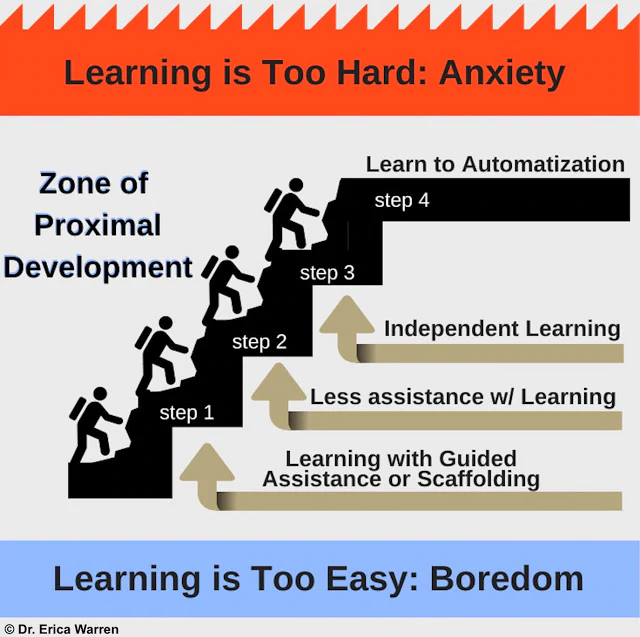
Hence, balance. The teacher's role, as I see it, is to provide just enough support, or scaffolding, to facilitate the learning. The teacher is responsible for providing enough assisted practice to help the learner internalize the strategies to complete the task or learn the new concept. The teacher aids the students in building on what (s)he already knows to learn what (s)he's trying to learn. The teacher builds on the learner's scaffolds to help develop the learner's ZPD. There needs to be a certain level of "imbalance" - or disequilibrium- internally with the student in order to achieve learning. Learning happens because of-not in spite of- this imbalance. The disequilibrium starts the learner's cognitive growth so that his equilibrium can once again be restored.
Knowing what we know about the necessity of disequilibrium, it isn't too much of a stretch to assert that being comfortable, not challenged and uneasy, makes one less likely to learn. It is that uncertainty, the disequilibrium, that signals the brain to start the learning process. Therefore, one can surmise that being comfortable essentially acts as a "kill switch" to your brain when in the learning process. Think about the way a first grader learns to write and form letters: a teacher provides guided opportunities for writing (through modeling in the air, on the board, in sand, with one's finger on a peer's back, on one's forearm, etc.) then moves (through a gradual release) to providing tracing worksheets the student completes independently. This process continues as the student works more independently with the teacher being less involved as the student masters the concept. Another example is the manner in which early readers learn to read. The teacher scaffolds the learning by using what the child already knows (s says /s/, a says /a/, t says /t/, models how to put them together (blend) and they become /sat/. The teacher has modeled then has students attempt to "blend" sounds, then has students "read" the word (maybe with a picture icon for support). The teacher, once again, has modeled and provided support through the student's disequilibrium in his ZPD then uses a gradual release as the student becomes more independent. Eventually, the student will demonstrate mastery of the concept.
"When we get too comfortable, we stop learning."
Now consider the scenarios discussed above again. If the teacher in the writing example gave no support and did not consider where the child was academically, the learning would have been too hard and the child would have been frustrated. As a result, no learning would have taken place. Conversely, if the teacher had given too much support without opportunities for independent practice or made the task too easy, the student would have been bored. Likewise with the reading example. Too much support or if the task is too easy, then the learner does not enter the state of disequilibrium and thus, does not begin the learning process. When we get comfortable, we get stagnant. In order to grow and learn we have to go through periods of uncomfortableness-to enter the state of disequilibrium-and ultimately, to grow and learn. I'm sure you've heard the old saying, "If you always do what you've always done, you'll continue to get what you've always gotten." So my advice to you is, if you want to learn, get out of your comfort zone. Find something in that "sweet spot" (your ZPD) and learn something new. Until next time, readers! 


